
Health technologies increasingly turn our bodies into data, but ownership and consent get lost in translation.
05 November 2026 · Giulia Campaioli · #DATAGOV #HealthTechs #DigitalRights #Brazil
I am sitting in the waiting room of my new dentist’s office in Barcelona for a cleaning. The receptionist mentions a “free” preliminary exam. Soon, a nurse leads me into a small room and asks me to remove my glasses for an X-ray. As I bite into the silicone guard that protects the machine’s nozzle, I catch my reflection in the metallic mirror and wonder: Why am I doing this radiography and how come it is free?
After the scan, I’m asked to sign a consent form, dense text, small font, the clock ticking. “I’d rather not give consent for photos or videos,” I tell him. “Of course,” he smiles, “none taken.” On my way out, I ask for a copy of the consent form and the X-rays. “Here is the consent form”, the dentist hesitates, “the X-rays results cost sixty euros.” “But you already have them,” I reply. “Yes,” he answers, “we need them for diagnostic purposes.” I leave without the images of my own body.
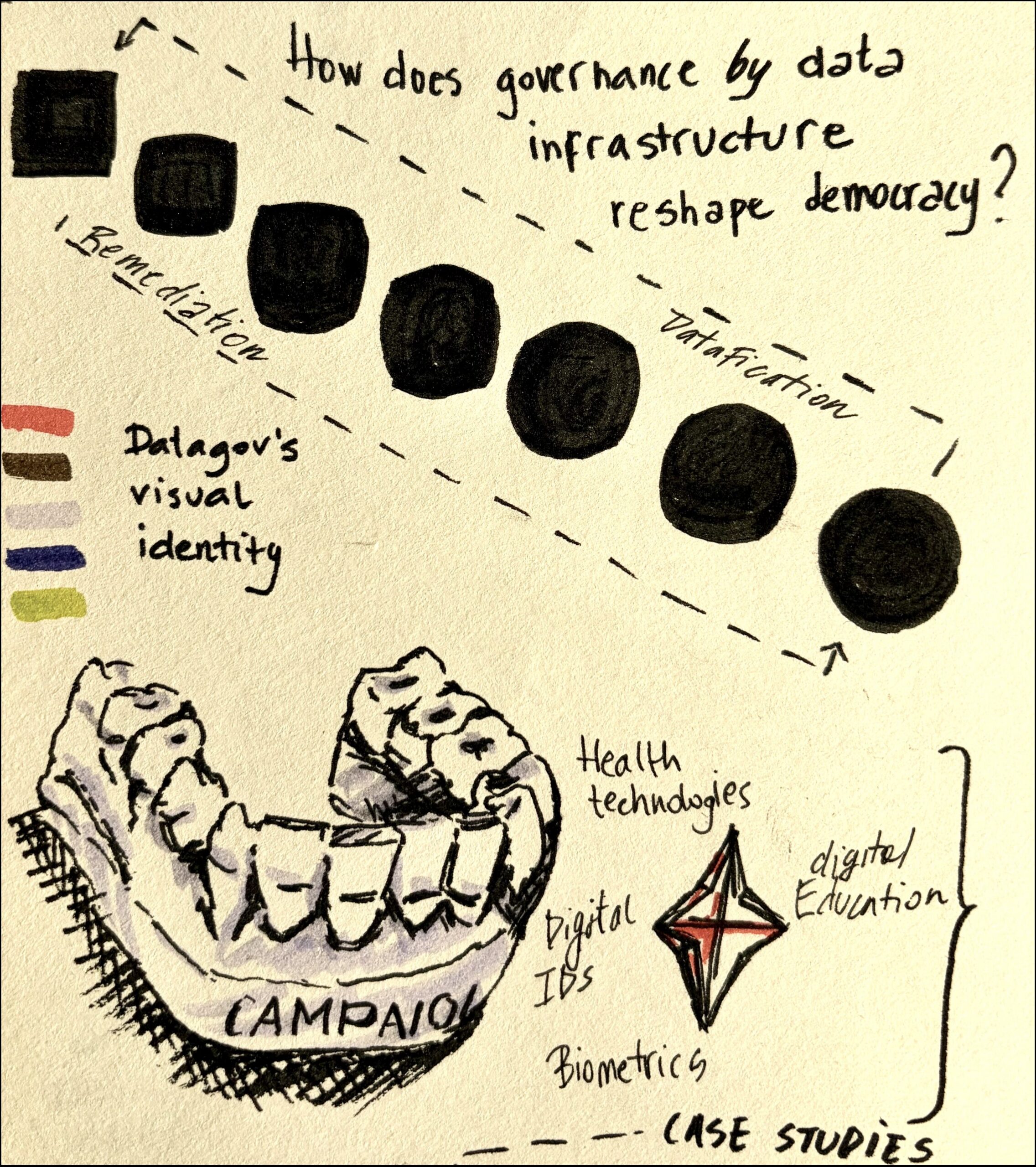
Health technologies are increasingly turning our bodies into digital data. Although the new dentist’s tool made my experience as patient significantly better, we know that the price of datafication is the loss of control over our data. What consent is implicated in the shift of public health governance towards data infrastructures? Who benefits from this shift, and who bears the burden?
Regulatory Health Data Infrastructures: Lessons from the DATAGOV Kick-Off Event
Digital health strategies expanded dramatically after COVID-19. Several liberal democracies – including Brazil, India, South Africa and the EU – are implementing digital health strategies, including identity verification systems for accessing public healthcare services and personal data, interoperability of health data, and health dashboards. On one hand, this digitalization of health care simplifies our lives. On the other hand, some concerns arise. Patient portals and disease dashboards gather, match, and store personal health data, but these public data infrastructures are often developed and maintained by an intricate network of private and public actors. In many cases, transparency is absent. Patients don’t know where their data goes, who accesses it, or how it might be repurposed.
Brazil’s digital health policy has moved from a broad modernization plan to a more data‑driven, operational model. The Digital Health Strategy 2020–2028 focused on national infrastructure, interoperability, and long‑term governance for the Unified Health System (SUS). The newer e‑SUS strategy shifts toward standardized data collection, municipal compliance, and performance‑based management. Algorithmic systems now shape regulatory decisions, resource allocation, and public health oversight across Brazil’s Unified Health System.
During the first day of the DATAGOV Kick-Off event in March 2026, our expert guests participated in two collective conversations on the conceptual tensions that characterize the field of governance by data infrastructure. After these plenaries, we moved to three breakout sessions, one of which on health technologies. In turns, we invited a group of three guests to turn these tensions into concrete research directions. Which pressing questions do health data infrastructures raise?
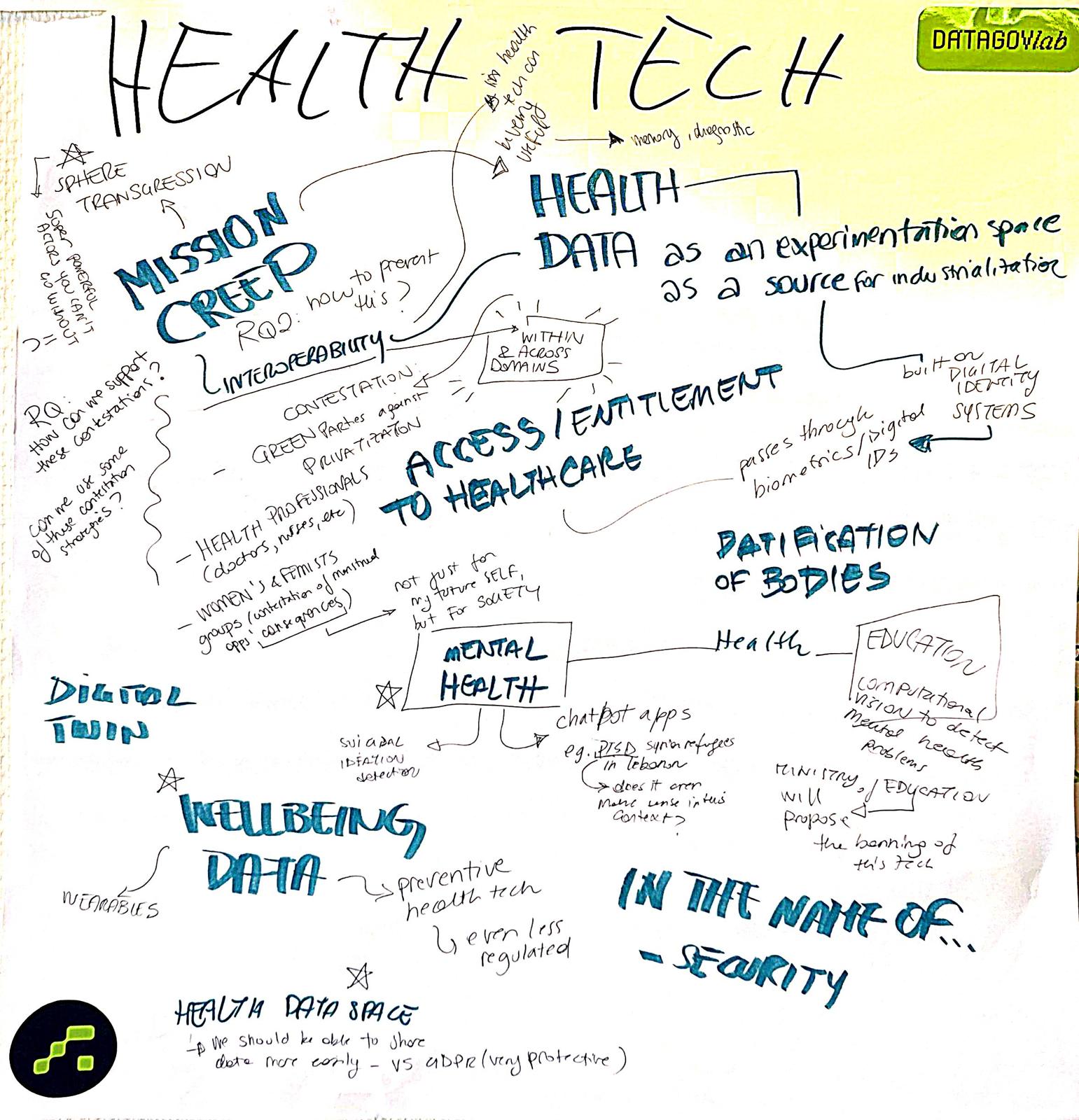
Health data was immediately identified as a site of experimentation and source for industrialization. The datafication of bodies has proceeded from health to wellbeing: wearables and preventive health apps increasingly collect wellbeing data, which too often falls unregulated. The table interrogated the issue of mission creep, or in Marjolein Lanzig’s terms, sphere transgression. Can interoperability support the circulation of health data within the domain of health and improve diagnostic precision? Does interoperability in the health sector extend the reach of other regulatory domains – policing, education, migration – and if so, with what consequences for democracy?
The connections between the three types of regulatory data infrastructures – health, e-education, and biometrics/digital IDs – were inevitable. Biometric systems and digital identity systems are not only mediating access to online health care portals, they are increasingly mediating access to private fitness and health infrastructures – such as fingerprint to access most gyms in Rio de Janeiro – often in the name of security. In Brazil, as recounted by Fernando Filgueiras, the Ministry of Education has recently halted a legislation which would implement facial recognition systems in schools to detect youths’ mental health conditions.
The breakout session also contemplated the growing presence of contestation. Luise Amoore recounted that health professionals in the UK are organizing and questioning the adoption of Palantir within the National Health System, women and feminist movements have been highlighting the risks of period tracking and fertility apps, green parties have been contesting the privatization of health care infrastructure. How can we, as academics, voice these contestations?
What consent to our data-bodies?
The Genealogy of Technology and Power since 1500, a massive art piece by Kate Crawford and Vladan Joler (2023) reminds us that the act of counting has always been within the operate of states, to manage the population, protect domestic security, and preserve public health. In the realm of surveillance devices, health technologies have historically been a site of datafication of bodies, a tool of the state to categorize, count, monitor and control populations and individuals. Yet, the institutional capacity to count and correlate has exploded in the age of big data. Citizens are turned into data subjects, and opting out seems impossible.
The Brazilian organization Coding Rights delved into feminist approaches to consent to our data-bodies. Their research investigates data protection consent models through feminist understandings of consent, revealing the power imbalances that popular models replicate. They argue that our digital selves—our data bodies—are inseparable from our physical selves. This framework challenges how we think about datafication. When the dentist captured an X-ray of my teeth, he wasn’t just documenting my dental health. He was creating a digital twin, quoting Louise Amoore, that can circulate, be analyzed, potentially profit others—while my physical body walked out the door without access to it.
As part of the DATAGOV project, I will investigate Brazil’s evolving digital health governance—transitioning from the 2020–2028 Digital Health Strategy to the newly instituted Digital SUS Program—to understand how this shift reshapes access to healthcare. As Brazil positions digital health within broader concerns of digital sovereignty and expanding access to healthcare, questions arise about whether these transformations actually mitigate (infra)structural inequalities, or whether they reproduce them. By situating inequality at the infrastructural level—across hardware, standards, policies, and institutional arrangements— my project seeks to understand for whom digital health infrastructures expand access to care, and for whom they generate new barriers.
To start off this new project, I will be traveling to Brazil this November to speak with public servants, activists, scholars and other experts interested in the digitalisation of the National Healthcare System (SUS). In particular, there are two upcoming events that I co-organized with colleagues from Rio de Janeiro, and which I will be attending during this time in Brazil.
On November 9, 2026 the seminar Ativismo digital no combate à violência contra mulheres e meninas will take place from 8:30 to 16:00, at the Centro de Estudos Olinto de Oliveira (CEOO), Anfiteatro A, Av. Rui Barbosa, 716, Flamengo, Rio de Janeiro.
Organized by the Instituto Nacional de Saúde da Mulher, da Criança e do Adolescente Fernandes Figueira (IFF/Fiocruz), with support from CNPq, the seminar brings together researchers, health professionals, activists, and content creators to discuss how digital tools can help address violence against women and girls. The program includes:
- 9:30 am: Digital technologies for monitoring and identifying cases of violence
- 11:00 am: Digital technologies and digital health for women experiencing violence
- 2:30 pm: Digital activism in confronting violence against girls and women: a conversation with collectives and influencers
The second event, Saúde Digital: Debates e Desafios, is a conversation between experts of Digital Health and Open Health, and it will take place at the auditorium of the Fundação Getulio Vargas (FGV) on November 24, 2026 from 14:00 to 16:00. This seminar brings together public servants, researchers and activists to discuss how different sectors can collaborate on the digitalization of SUS in a way that involves the citizenship and so safeguards democracy.
The program will feature an opening session led by Nicolo Zingales (FGV) and Giulia Campaioli (UVA), followed by keynote presentations by Adriana Macedo Marques (SEIDIGI), Anabelle Macedo Silva (Public Prosecutor’s Office of the State of Rio de Janeiro (MPRJ)/Federal University of Rio de Janeiro (UFRJ) – Federal University of Rio de Janeiro) and Flavia Harumi Ramos Tanaka (ANS).
The event will continue with a Q&A session open to the public, providing a space for exchanging perspectives and discussing the challenges of the digital health agenda
📅 November 24 | 2:00 p.m. to 4:00 p.m.
📍 FGV Direito Rio – Praia de Botafogo, 190, Room 824
Register (in-person): https://rb.gy/fcjbt1
Attend the event online: https://lnkd.in/dYVb8QiJ